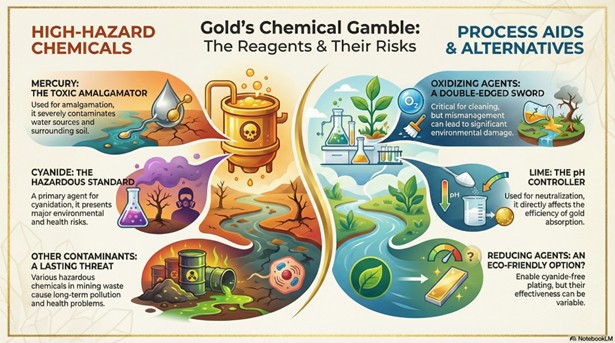
Gold panning and processing activities involve the use of several key chemicals that function to separate gold from sand or rock. Among the most common are mercury, which is used in the assimilation method because of its ability to bind gold directly, and cyanide, which is used in the cyanidation process to dissolve gold, especially fine particles. Although effective, both of these substances are very dangerous: mercury is neurotoxic and easily contaminates water and soil, while cyanide can cause acute poisoning to humans and aquatic life if not controlled. Support materials such as lime are used to maintain the appropriate alkaline pH, while others such as sulfuric acid and hydrogen peroxide are used at certain stages of cleaning and treatment. Mining waste often contains hazardous heavy metals such as arsenic, lead and antimony that can persist in the environment for a long time.
From an extraction efficiency perspective, chemicals affect the extent to which gold can be released from the mineral matrix. Mercury is effective for traditional methods but less effective for very fine gold, and carries a high health risk. Cyanide is more effective for fine gold, but its effectiveness is highly dependent on pH control and ore composition; the presence of metals such as copper can reduce efficiency as they also react with cyanide. As environmental awareness grows, more sustainable alternatives such as thiourea, ascorbic acid and sodium borohydride are being developed to replace cyanide for some purposes, although their effectiveness has not yet been thoroughly studied. Hence, public understanding of the functions and risks of these chemicals is essential to promote safer, more controlled and sustainable gold panning practices.
Prepared by: Dr Mohd Rashidi Abdull Manap AMRSC, FSSM, a faculty member at the Department of Chemistry, Universiti Putra Malaysia (UPM).
Date of Input: 05/02/2026 | Updated: 05/02/2026 | hidayahsaleh
MEDIA SHARING