Each year on 26 June, the world marks the International Day Against Drug Abuse and Illicit Trafficking, a date established by the United Nations General Assembly in 1987 to reaffirm global solidarity in the fight against drug-related harm. This year’s theme, “Break the Cycle. #StopOrganizedCrime,” is a timely and urgent reminder that the drug problem is not just a criminal justice issue-it is a deeply rooted public health crisis that requires collective action, scientific insight, and sustained investment in prevention.
The global drug trade continues to evolve at an alarming rate. New synthetic drugs (Figure 1), counterfeit medications, and highly addictive substances now reach communities faster than enforcement agencies can react. At the same time, people who use drugs face stigma, marginalization, and limited access to care. The results are devastating: rising overdose deaths, growing health inequities, and increasing pressure on justice and healthcare systems.
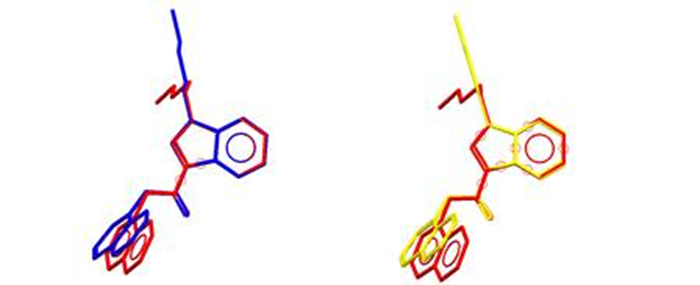
Figure 1. Overlay crystal structure (red) without hydrogen atoms with computational structure (blue and yellow illustrate DFT and HF structures, respectively) of a new synthetic drug of PB-22. Overlaid 9 atoms in indole.
We must change course. The evidence is clear: prevention works. Investing in education, community support, mental health services, and scientific tools for drug detection can save lives. Chemistry offers us reliable solutions-advanced instruments such as FT-IR spectroscopy, NMR, and X-ray technologies allow authorities and harm reduction teams to identify dangerous substances quickly, accurately, and non-destructively. At festivals, in clinics, and on the streets, these tools are already helping prevent overdoses and flag counterfeit drugs.
But technology alone is not enough. Local researchers, including university chemistry lecturers, need more research funding and less bureaucratic red tape. We also need societies that are willing to talk openly about addiction, treatment, and what it takes to build safer, healthier communities
On this World Drug Day, I urge policymakers, educators, healthcare workers, and citizens alike to act. Let’s fund the systems that prevent abuse before it begins. And let’s break the cycle-together.
Dr Mohd Rashidi Abdull Manap AMRSC, FSSM is a faculty member at the Department of Chemistry, Universiti Putra Malaysia (UPM). In addition, he is a Visiting Research Fellow at Lund University, Sweden, currently based at BMC - Biomedicinskt Centrum.
Date of Input: 04/07/2025 | Updated: 04/07/2025 | harithdaniel
MEDIA SHARING