Introduction: A New Molecular Architecture for a New Era
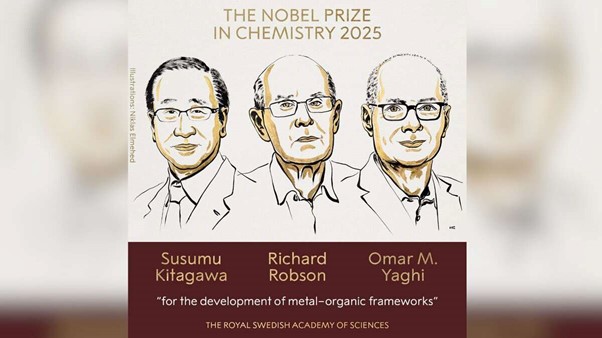
The awarding of the 2025 Nobel Prize in Chemistry to Susumu Kitagawa, Richard Robson and Omar M. Yaghi recognizes the creation of a fundamentally new class of materials — metal–organic frameworks — distinguished by their ability to combine metal ions with organic linkers to form crystalline networks filled with vast internal cavities.These “molecular architectures with space inside” fundamentally expand the design possibilities of materials science, enabling customizable properties for gas storage, separation, catalysis, water harvesting, and beyond.
A tiny fragment of MOF material — no larger than a sugar cube — can harbor an internal surface area comparable to that of a football pitch, a dramatic leap in storage and adsorption capacity relative to traditional materials. This feature promises a paradigm shift in how we store, separate, or reclaim molecules, with implications across energy, environment, industry, and public health.
Scientific Foundation: Why MOFs Are Different
Rational design and “reticular chemistry”
Unlike traditional materials discovered serendipitously, MOFs arise from a rational design strategy combining metal ions (as nodes) with organic molecules (as linkers) to build extended, periodic structures. This method permits fine control over pore size, geometry, and chemical functionality, enabling scientists to tailor a MOF’s internal structure to match a desired application whether for capturing COâ‚‚, storing hydrogen, filtering water contaminants, or catalyzing chemical reactions.
The work of Kitagawa and Yaghi established that MOFs could not only be formed, but also remain stable (thermally and chemically) and “permanently porous” i.e., maintain their internal cavity structure even when emptied of guest molecules. This stability is critical for real-world applications.
Exceptional internal surface area and tunable porosity
The extraordinary internal surface area of MOFs underlies their utility. For example, the classic MOF known as “MOF-5” exhibits such enormous internal surface area that just grams of it can adsorb amounts of gas far exceeding those stored in conventional materials.
Moreover, by modifying the organic linkers and metal nodes, thousands of MOF variants have been synthesized each with distinct pore sizes, shapes, chemical affinities, and physical properties. This tunability means that MOFs are not a single material, but rather a vast “toolbox” of materials, each optimized for specific molecular functions.
Immediate and Emerging Applications: From Lab to Real-World
The discovery and subsequent development of MOFs have already enabled a wide array of potential and emerging applications. Some of the most promising include:
- Carbon dioxide capture and sequestration:
Certain MOFs can selectively adsorb COâ‚‚ from gas mixtures such as flue gases from power plants or industrial processes, offering a possible technology for reducing greenhouse-gas emissions.
- Hydrogen and gas storage:
Because of their large internal cavities and surface area, MOFs are promising for storing hydrogen or natural gas in a dense, safe, and efficient way — a potential pillar for future clean-energy systems.
- Water harvesting from air and water purification:
Some MOFs can capture water vapor even from low-humidity air and then release liquid water when heated — a powerful approach for providing potable water in arid regions. Additionally, MOFs can be engineered to filter out contaminants from water, including persistent “forever chemicals” or toxic pollutants.
- Catalysis, chemical separation and remediation:
MOFs’ internal cavities can host catalytic sites, enabling transformations of captured molecules (e.g., decomposition of pollutants, conversion of chemicals, or even drug-delivery contexts).
- Energy storage & electronics:
Some MOFs have demonstrated proton conductivity or other conductive or catalytic properties — opening pathways toward battery materials, fuel cells, or other advanced energy-related applications.
Prepared by: Chm Dr. Mohd Izham Saiman, MRSC, a senior lecturer in the Department of Chemistry, Faculty of Science, Universiti Putra Malaysia (UPM).
Date of Input: 12/12/2025 | Updated: 12/12/2025 | hidayahsaleh
MEDIA SHARING