Challenges and the Path Ahead
While the potential of MOFs is enormous, there remain important challenges before many of these applications become widespread:
- Scalability and cost: Lab-scale MOFs can be synthesized relatively easily, but producing them at industrial scale in large quantities, with consistent quality, durability, and low cost remains non-trivial. Some progress has been made, but widespread deployment will require advances in manufacturing.
- Stability and robustness under real-world conditions: While many MOFs are thermally and chemically stable under lab conditions, exposure to moisture, fluctuating temperatures, impurities, mechanical stress or repeated cycling may degrade performance. Designing MOFs robust enough for harsh industrial or environmental use remains an active research challenge.
- Selectivity and regeneration efficiency: For applications such as carbon capture or water harvesting, the MOF must not only adsorb the target molecule effectively but also release it in a controllable, energy-efficient manner for reuse or safe disposal. Engineering such selectivity and reversibility is a key hurdle.
- Environmental and health safety: As with any new materials, large-scale use of MOFs will need careful assessment for toxicity, ecological impact, and lifecycle environmental costs. The sustainability benefits should outweigh any unintended side-effects.
Conclusion: A Transformative Foundation for the 21st Century
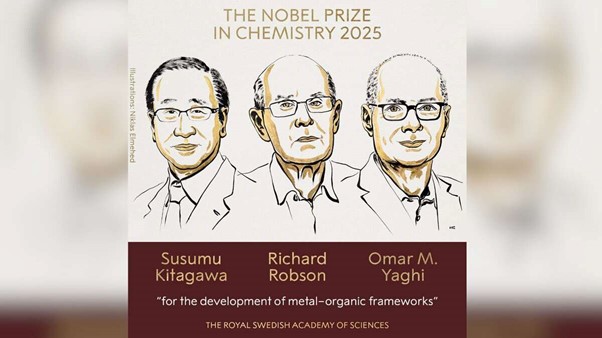
The 2025 Nobel Prize in Chemistry honors not only a brilliant intellectual achievement, but also a threshold: the emergence of a new paradigm in materials science. With MOFs, chemists gained the ability to engineer porous, functional, and highly customizable materials — akin to constructing molecular “hotels” or “apartments” for gases and molecules. This innovation unlocks enormous potential across renewable energy, environmental remediation, water security, carbon management, and sustainable chemistry.
As research advances, and as challenges of scalability, stability, and cost are addressed, MOFs may increasingly move from academic curiosity to industrial backbone. In a world facing climate change, growing energy demand, water scarcity, and environmental pollution, MOFs offer a hopeful scientific toolset — one that may help transform some of our biggest challenges into opportunities for a more sustainable, resilient, and cleaner future.
References:
- Nobel Prize Press Release: The Nobel Prize in Chemistry 2025 – NobelPrize.org
- Nobel Prize Popular Information: Metal-Organic Frameworks: Molecular Architectures with Space Inside – NobelPrize.org
- Nobel Prize Advanced Information on the 2025 Chemistry Prize – NobelPrize.org
- ScienceLine: 2025 Nobel Prize in Chemistry Recognizes Development of New Molecular Architecture
- Chemistry World: How the Pioneers of Metal–Organic Frameworks Won the Nobel Prize
- The Chemical Engineer: MOF Pioneers Win 2025 Nobel Prize in Chemistry for Breakthroughs in Carbon Capture and Water Treatment
- Reuters: Trio Win Nobel Chemistry Prize for Developing “Hermione’s Handbag” Materials
- Washington Post: Nobel in Chemistry Goes to Molecular Breakthroughs With Climate Applications
- LiveScience: ‘Harry Potter’-like Materials Land Three Scientists Nobel Prize in Chemistry
- Associated Press (AP News): Nobel Prize in Chemistry Goes to Discovery That Could Trap COâ‚‚ and Bring Water to Deserts
- arXiv: AI-Driven Design of Metal–Organic Frameworks
Prepared by: Chm Dr. Mohd Izham Saiman, MRSC, a senior lecturer in the Department of Chemistry, Faculty of Science, Universiti Putra Malaysia (UPM).
Date of Input: 12/12/2025 | Updated: 12/12/2025 | hidayahsaleh
MEDIA SHARING